Frequently Asked Questions
Water Resistance - I do not recommend getting any mechanical watch wet. My guarantee
does not cover water damage of any sort (including fog in the crystal). Many of
the internal parts of a watch are made from steel (not stainless), and are therefore
prone to rust. A small amount of water that gets inside the case can easily destroy
a watch, with repair costs easily exceeding $1000. It is just not worth the risk. I
suggest you use an inexpensive quartz watch for swimming. Also, understand that
many vintage watches (pre 1960 or so) had no seals at all, and aren't even splashproof.
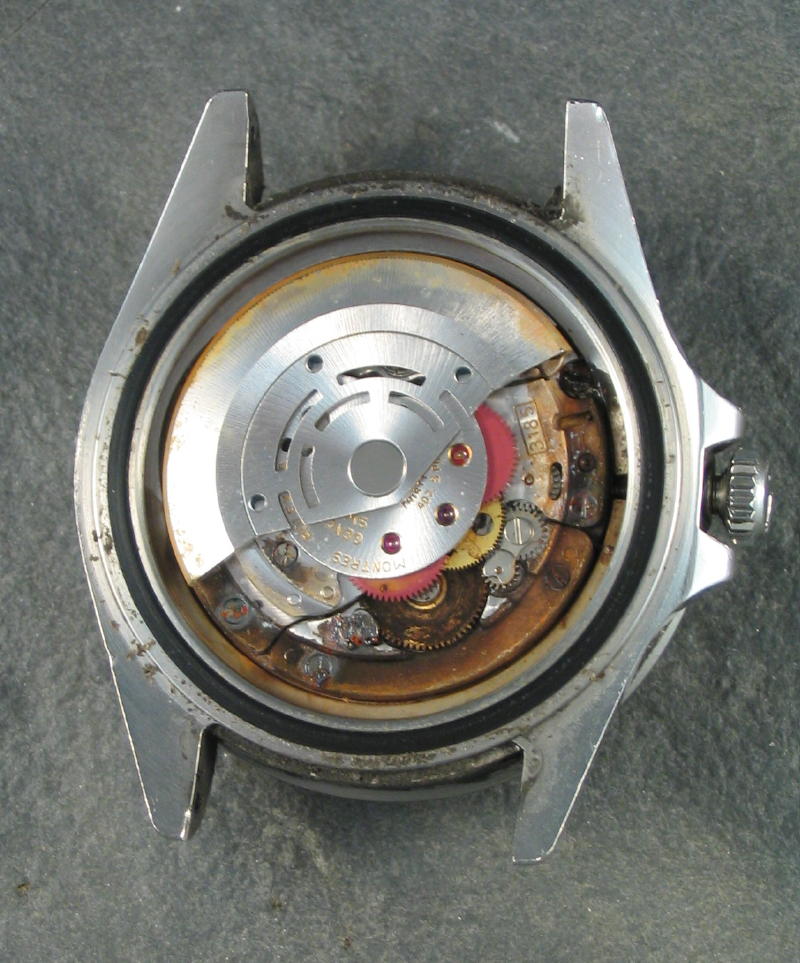
Here is a photo of a Rolex GMT that got wet. If you look carefully, you can see
that the case tube got stuck in the crown (it should stay in the case). This is
where water entered the case. This repair is over $2000.
Shipping Recommendations - I recommend that you use Registered US Mail when sending
your watch in for repair. You should pack the watch in a box, and use paper tape
to seal the seams. The post office will stamp the seams to show that the box has
not been tampered with during shipping. On the Registered Mail form, there is a box
to check to insure the package, and it can be insured for up to $25,000. Registered
Mail is handled separately from the rest of the mail, and is therefore more secure
than plain 'Insured' Mail (in fact, everyone who handles a Registered package has
to sign for it throughout its transit). Insured Mail uses a blue sticker/form, while
Registered uses a red sticker. Insured Mail is adequate for packages valued at less
than $500. There is a price break (at about $500) where Registered Mail is actually
cheaper than Insured. Additional insurance for Registered packages is relatively
inexpensive, so I generally over-insure packages. Generally, a package shipped Registered
US Mail and insured for a few thousand dollars will cost about $25 to ship including
insurance costs.
Also, keep in mind that shipping to a PO Box is safer than shipping to a physical
address. Registered packages are kept in a safe inside of a locked cage which is
inside the post office. If you ship to a physical address (using US Mail, UPS or
FedEX), the package is basically on a tour of the area inside of an unlocked truck. Shipping
via Registered US Mail is very secure.
Please include a note with your name, address, phone number, and e-mail address. Also,
be specific as to what you want done. The more specific you are about the problems,
the better I can meet your needs. I refer to your notes during the repair to make
sure that I address all of your concerns, so if it is not in your notes it might
not get done.
Historical & Value Information - I welcome any questions specifically regarding the
repair of a watch, such as: can I fix this brand?, can I fix this problem?, approximately
how much will it cost?, what kind of performance can I expect?, etc. However, I get
numerous inquiries from people looking only for general information on their particular
watches, such as: what can you tell me about this watch?, when was it made?, how
much is it worth?, etc. Unfortunately, I do not have time to answer these types of
questions. For historical information, I suggest you obtain the book, the Complete
Guide to Watches, by Cooksey Shugart, Tom Engle & Richard Gilbert. It has a lot of
historical information, pictures, and a price guide. This book can be bought at a
local bookstore, borrowed from the library, or purchased at an on-line bookstore.
Another good source of value information is checking the completed auctions on ebay.
This will allow you to see an actual sale price, as opposed to an asking price.
Plastic vs. Sapphire Crystals - Watches that originally came with plastic crystals
cannot be converted to use a modern sapphire crystal. Plastic crystals are domed
higher than sapphire crystals, and therefore provide much more hand clearance. If
you tried to fit a sapphire crystal, the hands would bind on the crystal and the
watch would stop. Mineral/sapphire crystals didn't become popular until the 70's
or 80's, so most round vintage watches originally came with plastic crystals. Some
of the very early watches used glass crystals, especially in the fancy (non-round)
shapes.
There is no reliable way to properly fit a sapphire crystal onto a Rolex which originally
came with a plastic crystal, as the cases are designed specifically to accept a plastic
crystal This is especially true for bubblebacks and other early Rolex watches. Some
of the 'sapphire conversion' crystals for watches made in the 1970's era don't fit
quite well enough to seal properly.
Watch Winders - There seem to be a lot of different opinions on the use of watch
winders. My opinion is as follows. The main issue with watch winders, in my opinion,
is wear and tear on the movements (especially in the autowind section). I think you're
better off not running your watches if you're not going to wear them (although I
think it's probably a good idea to run them at least once every two weeks or so.)
If you're going to use a watch winder, it makes sense to run it for the minimum amount
of time to wind your watches, so as to minimize wear on the movement. I don't recommend
putting most vintage watches on a winder, as finding replacement parts for a worn
vintage watch can be difficult and costly. Some movements, like the vintage Rolex
bubbleback, have early autowind mechanisms which are prone to wear. This is much
less of an issue with modern pieces. In short, I think watch winders are probably
OK for most modern watches, but probably aren't a good idea for vintage pieces.
Watch Parts - I do not sell watch parts outright. Of course, I will take care of
finding all necessary parts when I service your watch. If you have a piece that someone
else could not find parts for, you are welcome to send the entire watch to me for
servicing and I will take responsibility for finding the correct parts and repairing
the watch.